The Best Meditation Style For Your Mind-Body Type
Our experience of life is shaped, in large part, by the patterns of our mind. The way we pay attention, interpret events, and respond to our thoughts influences how we move through the world. Few practices have been studied as extensively as meditation for their ability to cultivate greater awareness, presence, and well-being.
One of the biggest misconceptions about meditation is that there's one "right" way to do it. In reality, meditation comes in many forms, and different practices resonate with different people. Whether you're new to meditation, exploring mindfulness meditation for the first time, or you've tried meditation and thought, "This just isn't for me," it may simply be that you haven't found the approach that feels right for you yet.
How wonderful, then, that meditation comes in many forms too. In fact, almost anything can become a kind of meditation when approached with presence and intention. And just as a size 7 shoe is unlikely to fit a size 10 foot comfortably, a meditation practice that works wonderfully for one person may not work nearly as well for another.
The suggestions below are inspired by long-standing mind-body typology systems, including somatotypes (ectomorph, mesomorph, and endomorph) and the ways these patterns have often been associated with certain personality and nervous system tendencies. These frameworks aren't meant to define you or predict your experience. Rather, they offer one lens through which you might better understand yourself and explore meditation practices that feel supportive. Take what resonates, leave what doesn't, and remember that your own experience is always the best guide.
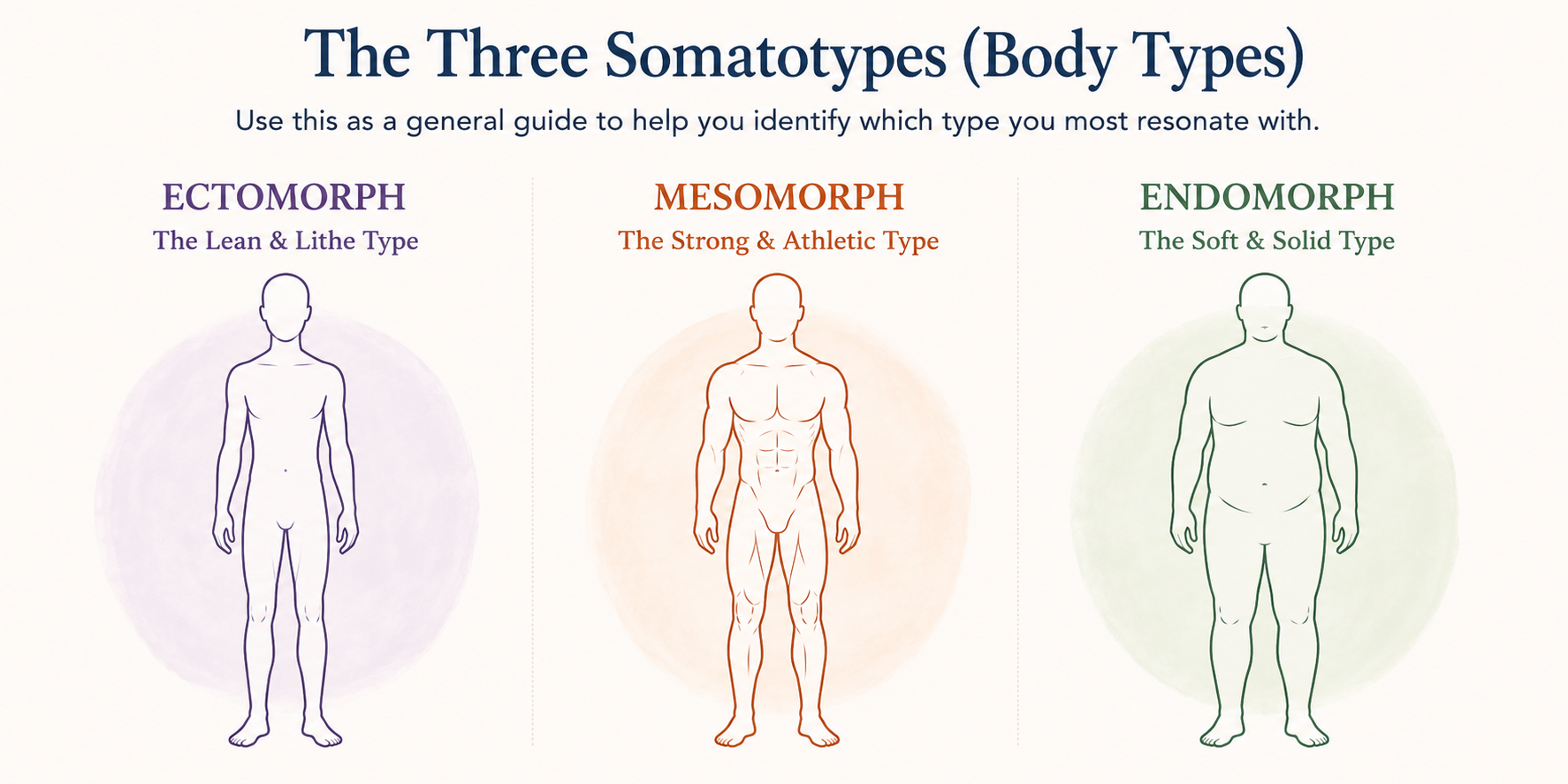
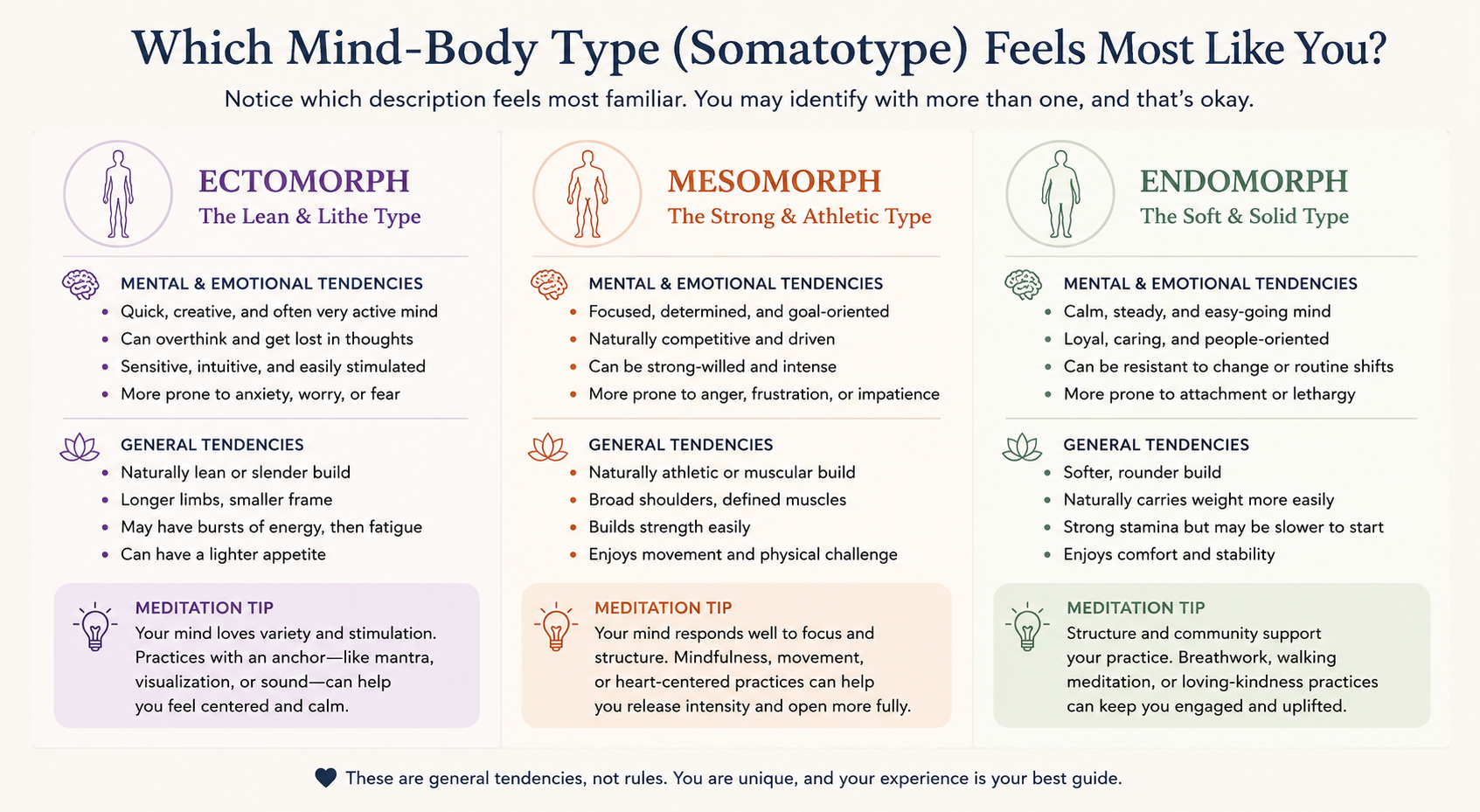
You don't need to identify perfectly with one category to benefit from these suggestions. As you read, simply notice which description feels most familiar. You may see yourself strongly in one type, recognize aspects of more than one, or find that your tendencies shift over time. The goal isn't to label yourself — it's to discover practices that help you feel more present, grounded, and alive.
The best meditation isn't the one someone else tells you to practice. It's the one you'll genuinely want to return to.
Ectomorphs, here is the perfect meditation for your naturally active mind.
Ectomorphs tend to have a naturally leaner build and are often described as long-limbed or slender, though every body is unique.
If you identify most with the ectomorph body type (or what Ayurveda might refer to as "Vata"), you may also recognize some of the mental tendencies often associated with it — such as a busy, fast-moving mind. With a very active mind, you can get lost easily in your thoughts. Rather than trying to force your mind to become completely blank, you may find it more helpful to give it somewhere gentle to rest. Many people with an active mind enjoy mantra meditation, visualization, or focusing on sound because these practices provide the mind with a clear anchor instead of asking it to stop thinking altogether.
As an ectomorph, it is good for you to work with, not against, your naturally active mental energy, letting it flow as it wishes rather than trying to suppress it. You may find that you don’t have enough energy to concentrate, so when you’re lacking energy try deepening your breath to invite in more prana (life force energy) during your meditation practice. Many people also notice that a regular meditation practice supports better sleep, improved digestion, stronger immune function, and a greater overall sense of well-being.
Of all the emotional experiences available to us as humans, many people with ectomorph tendencies also notice that fear, uncertainty, or anxiety show up more readily. During meditation, it is therefore helpful to direct your mind back to your inherent fearlessness, peace, trust, and protection. Focusing on inner steadiness, trust, and safety – rather than the changes and disturbances of the external world – will help you maintain a calm, content mind capable of achieving all your goals and dreams.
Mesomorphs, mindfulness meditation was made for you.
Mesomorphs often have a naturally athletic or muscular build and may gain strength relatively easily.
You may especially enjoy mindfulness or mantra meditation because they give your naturally focused mind something steady to engage with. Because your mesomorphic personality (or what Ayurveda might refer to as "Pitta") lends itself to holding tight to opinions and judgments, meditation can especially be a great time to leave behind the limitations of the critical mind, and to experience your Higher Self beyond it.
Many people who identify with mesomorphic tendencies notice that frustration, irritability, or anger arise more readily than anxiety or withdrawal. In fact, many of life’s circumstances can become conquests and challenges for you. It is therefore important that you be mindful not to make meditation into a similarly competitive, goal-oriented activity, thereby negating the whole purpose of it. During meditation, concentrate on releasing stress and tension, foregoing the desire to control and strive, and opening your mind and heart to what’s possible. If this resonates with you, guided meditations focusing on love and compassion are great, especially those that invite you to visualize giving, asking for, and receiving forgiveness.
Most important of all in your meditation practice is emphasizing your body as a vehicle for anything that your mind yearns to achieve. As a mesomorph, you tend to be an active, somatically-focused being so combining meditation with movement can be a great way to settle your mind. In fact, movement can naturally become a meditation for you. So take your mind for a walk and focus on the feeling of your feet as you do so, or lie down and follow – with your attention – the sensations in your body from your head to your toes. Chanting, as a form of self-expression, is another wonderful modality to try!

Endomorphs, allow yourself to be held in the loving embrace of meditation.
Endomorphs tend to have a softer or rounder build and may naturally carry weight more easily.
If you identify as an Endomorph (or what Ayurveda might refer to as "Kapha"), you may find that meditating with other people or creating gentle structure makes it easier to maintain a practice. So find a group meditation class and perhaps invite a friend, partner, or child to come along with you. Because you have a propensity for lethargy and can fall asleep during meditation, more active meditations, such as those infused with periods of breathwork (pranayama) are great for you. Walking meditation is also a great option to sustain your wakeful attention while simultaneously enhancing your circulation.
Meditation teaches the principle of non-attachment: being with each moment as it arises rather than clinging —whether to relationships, jobs, or material things— in hopes that they will last forever. If you recognize a tendency to hold tightly to familiar people, routines, emotions, or circumstances, meditation can be a wonderful way to release these attachments and to help you move forward, inviting yourself to change along with a life that is always changing with or without you. You may also choose to recite an affirmation of freedom, independence, and non-attachment (eg “I deeply appreciate my life and the people and things within it while they are present, knowing they can change or cease to be at any time”) to help ease yourself into this understanding that all of life is impermanent and eventually gives way to something else.
Above all, know that you can support your naturally loving and caring nature during meditation by focusing your attention on love for all beings and for the divine (like in loving-kindness meditation), in whatever form it may come for you. And if you’d like to explore something very special to you as an endomorph, try the Hugging meditation created by Thich Nhat Hanh with a child (whether your own or the child of someone you know and love), a friend, or even a tree. First, recognize each other’s presence with a simple bow towards one another. Next, take three full, conscious breaths to welcome yourself into the present moment. Next, open your arms widely and hug, holding each other in a warm embrace for three in-breaths and out-breaths. While hugging, become aware that you and the other person are sharing a present moment together and invite yourself to feel the joy and gratitude that this togetherness brings. Complete the meditation by releasing and bowing to each other to show gratitude for the blessed time you spent together.

Whether you identified strongly with one type or found yourself somewhere in between, I hope these descriptions remind you of one thing: there is no one "right" way to meditate. And, you don't have to meditate the way everyone else meditates.
The best meditation isn't the one someone else tells you to practice. It's the one you'll genuinely want to return to, and that supports you in discovering the kind of presence that helps you feel more grounded, aware, and connected to yourself.
The best meditation isn't the one someone else tells you to practice. It's the one you'll genuinely want to return to.
Meditation isn't about doing it perfectly. It's about returning, again and again, to this moment—and finding the practices that make returning feel possible. The more your meditation practice fits you, the more likely it is to become something you actually look forward to rather than something you feel like you should do.
Ultimately, meditation is about learning to notice your inner world with greater awareness, curiosity, and compassion. Those same skills are at the heart of my course, Happy from the Inside Out®, where we explore how to understand the different parts of ourselves, navigate difficult emotions, and build a more peaceful relationship with our minds. If you're looking for support alongside meditation alone, I'd love to have you join us.