Why You Compare Yourself to Other People (And How To Stop)

We humans are so interesting, aren’t we? We often do things that make us feel like $#!+. Even when we know that it makes us feel like $#!+, we do it anyway.
One of the biggest offenders is self-comparison. We humans are remarkably good at finding ways to compare ourselves to other people — their appearance, success, relationships, confidence, accomplishments, personalities, lives.
Alas, I invite you to come with me on this lil’ written journey of uncovering why we do this thing that makes us feel so bad and what you can do about it all!
Why You Compare Yourself To Other People
The psychology behind why you compare yourself to other people can be summed up in three parts:
You want to assess your own progress, a very natural and helpful thing to do
You also want to feel good about yourself and maintain your self-esteem (so you inflate yourself with downward social comparisons and coincidentally, make yourself feel bad via upward social comparisons too)
Our minds are drawn toward comparisons that reinforce or reflect existing beliefs we already carry about ourselves.
And it’s this third point that’s really powerful. Simply stated:
You want to confirm what you already think… Our minds are often drawn toward confirming what already feels familiar or believable about ourselves.
And so, you find evidence in others to support what you think (for example, if you don’t feel good about your own weight and physique you find someone thin and fit to compare yourself to, or if you’re not the intelligent type you find someone incredibly smart to compare yourself to)
Even when those beliefs are painful, familiar narratives about ourselves can feel strangely convincing and emotionally familiar. So if a part of you already believes “I’m behind,” “I’m not attractive enough,” “I’m failing,” or “I’m not enough,” your attention may naturally gravitate toward comparisons that seem to confirm those fears.
How It Works
There are dozens or maybe even hundreds of people around you, depending on how you spend your days, and you could compare yourself to any one of them. Why do you think you choose the comparisons you do? To reinforce what you already believe, of course! And, well, to reduce the unsettling feeling that comes when our perceptions get challenged by new information...
You see, unless you were just born, you’re not an empty slate. You’ve had years and years to develop opinions about who you are and who you aren’t and you’ve got a sense of how you stack up against others in terms of looks, talents, smarts, and anything and everything else that might be important in the society in which you live.
And the way you see yourself shapes how you make sense of and act in the world around you. If you feel confident about your ability to do your job, for example, you’ll show up with more confidence and trust in your ability to navigate challenges and responsibilities. If you don’t feel confident about your ability to do your job, you’ll shy away from responsibilities and risks and feel incredibly stressed at work.
I’ve heard it said that when you’re comparing yourself to others, what you’re really doing is comparing your idea about yourself to your idea of them. And in many ways, I think that’s true. We all carry stories, assumptions, insecurities, beliefs, and perceptions about ourselves and other people, and those inner narratives often shape the comparisons our minds become drawn to.
In other words, self-comparison is rarely fully objective. We compare our inner world — including our fears, insecurities, longings, and self-perceptions — to the limited pieces of another person we’re able to see.
How to Stop Comparing Yourself to Other People
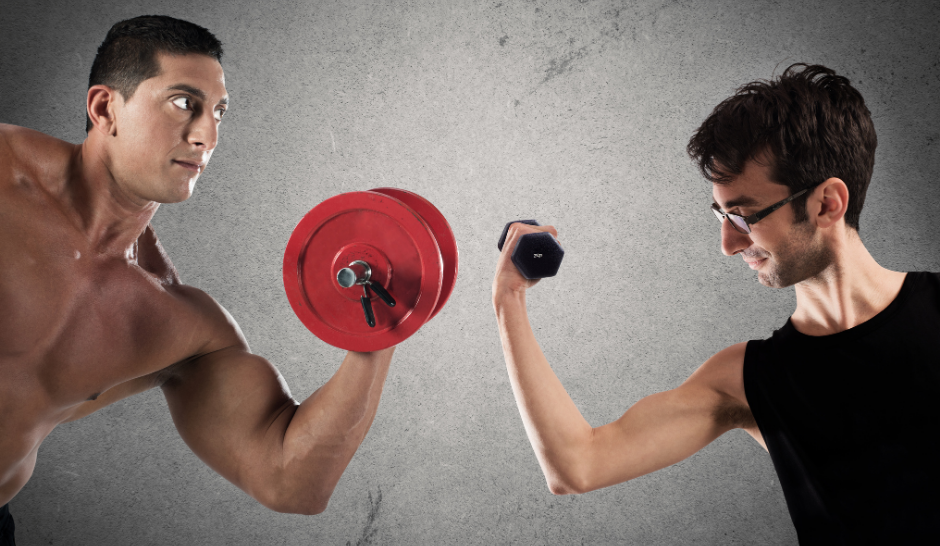
When people ask me “how do I stop comparing myself to other people?”, I often say “that’s a great question, but how about we ask a different one?” Since your comparisons of yourself to other people exist to affirm the view you already have about yourself, why don’t we start there, at the source, with your self-view? Why don’t we ask: “How do I develop a more accepting and compassionate relationship with myself so that when my mind looks outward, it’s not constantly searching for evidence of my inadequacy?”
And so, over time, reducing painful self-comparison often involves developing a different relationship with ourselves altogether. The more secure, compassionate, grounded, and accepting we become internally, the less intensely we tend to organize our worth around how we measure up to other people.
That doesn’t mean comparison disappears completely. Most humans compare themselves sometimes. But when our self-worth becomes less dependent on external validation, perfection, achievement, appearance, or being “better” than others, those comparisons often lose some of their emotional grip.
Part of this work involves becoming more aware of the beliefs we carry about ourselves, where those beliefs came from, and how we might begin relating to ourselves with more honesty, compassion, and flexibility over time.
If self-comparison feels painfully familiar, these are also some of the themes we work with inside my course Happy from the Inside Out® — especially the relationship between self-worth, inner criticism, emotional patterns, and the ways we learn to reconnect with ourselves more compassionately over time.
You can learn more about the course here.